
Playing with your cat: how long and how to go about it
There is no official duration, but there are guidelines: at least a few minutes a day, preferably in short sessions. Here is how to organise play, end it and adapt it to your cat.
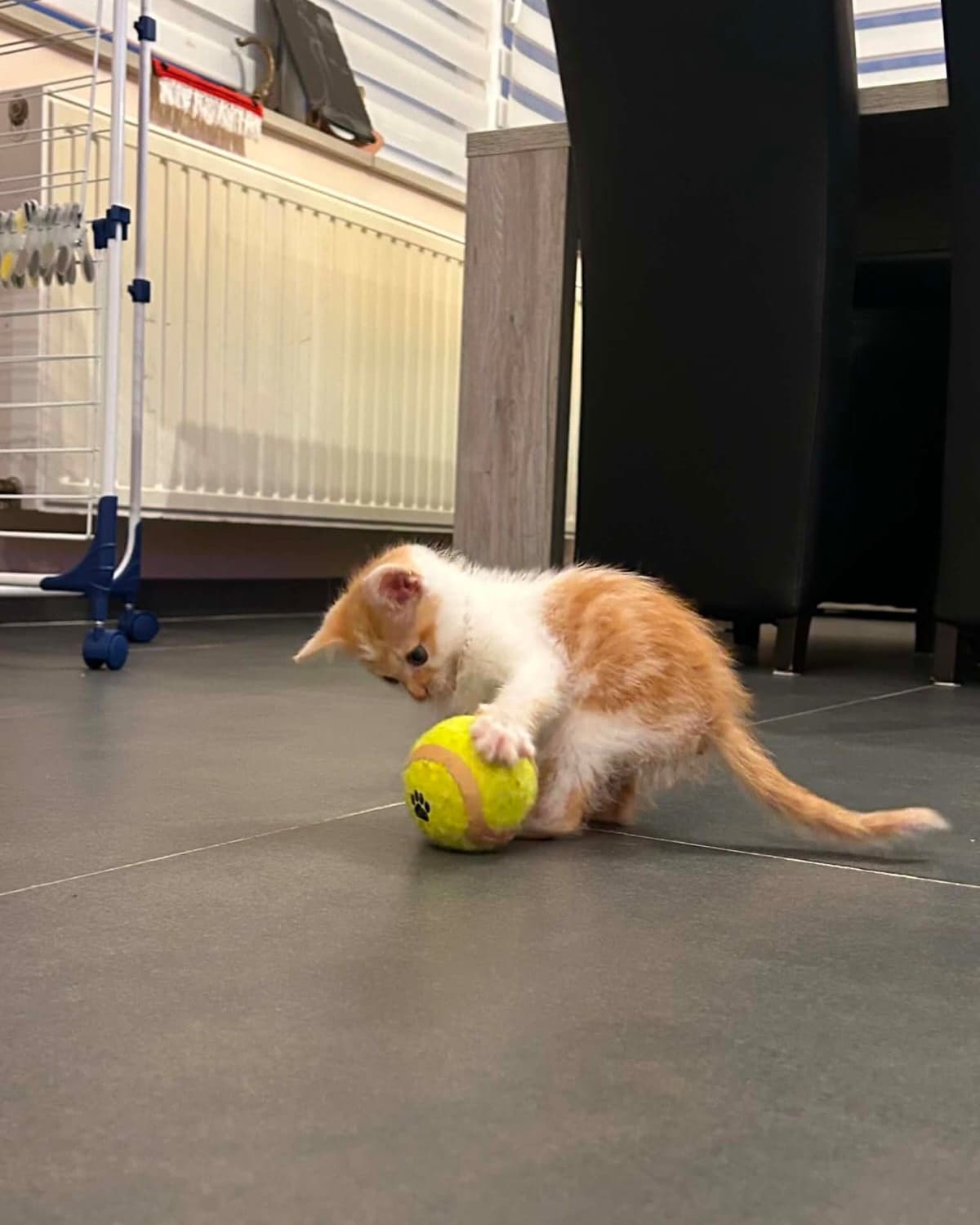
1. Why does a cat need to play?
Cats are predators: hunting means spotting, approaching, pouncing and catching. International Cat Care explains that this instinct remains very strong in domestic cats and that the motivation to hunt is only partly related to hunger. A well-fed cat therefore keeps the urge to hunt.
For an indoor cat, play is the chance to express this behaviour. The 2013 guidelines from the AAFP and the ISFM consider meeting a cat’s environmental needs essential, not optional. They point out that depriving a cat of the chance to behave as a predator can lead to obesity, boredom and frustration, which can show up as excessive grooming, stress-related illness or misdirected aggression.
2. How long should you play with your cat each day?
There is no official duration that suits every cat, and sources do not set it the same way. In its “Purrfect Play Every Day” campaign (2023), International Cat Care invites owners to play with each cat for at least five minutes a day with a wand toy; according to its survey, fewer than 30% of owners do. The Ontario SPCA talks about short sessions of 5 to 10 minutes, VCA about several sessions of around 10 minutes a day. The PetMD website goes up to two or three sessions of 10 to 15 minutes, without citing a study.
These figures are guidelines, not a measured threshold. Keep to the method instead: start with one or two sessions of 5 to 10 minutes a day, watch your cat and adjust. International Cat Care notes that a minute of intense activity is already a good result for many cats, and VCA that losing interest after a few minutes does not mean they dislike the toy.
End the session when your cat turns away or walks off: better to finish on a success than to tire them out. A highly motivated cat will play for longer, a less motivated one for less, and duration is not a goal in itself.
4. End the session with a “catch”
In the wild, a hunt ends with a capture, then a meal. The AAFP and the ISFM recommend letting the cat catch the toy to simulate a capture, then rewarding them with a treat; the Ontario SPCA suggests ending with a small snack or a meal, suited to the time of day. If you give a treat, count it in their daily ration.
Then put the wand away out of reach: a string left lying around can be a strangulation hazard (Ontario SPCA).
5. When to play, and what if they play at night?
Cats are more active at dawn and dusk (International Cat Care, Cats Protection). VCA therefore suggests playing in the morning and the evening. If your cat wakes you at night, VCA recommends offering play and meals during the day and evening, and discouraging evening naps; Cats Protection recommends plenty of play during the day to burn off their energy.
Avoid rewarding night-time wake-ups: VCA notes that any attention given at night can reinforce the behaviour. Cats Protection advises not to scold the cat, as they may be signalling that something is wrong: some illnesses cause night waking. If these wake-ups are new, sudden or come with other changes, ask a vet before looking for a behavioural explanation.
6. Mistakes to avoid: hands, laser alone, string
Avoid playing with your hands or feet: the AAFP and the ISFM advise against it in any kind of play, so that neither the cat nor you gets hurt. With kittens, International Cat Care insists: growing teeth and claws can hurt, and a kitten can learn to link fingers with play. A wand keeps some distance, which also limits scratches.
Avoid the laser pointer as your only toy: the dot lets a cat stalk, chase and pounce, but never catch (International Cat Care), which can be frustrating; Cats Protection recommends avoiding toys a cat can never catch. If you use a laser, always finish with a toy they can catch (International Cat Care), for example by stopping the beam on it (Ontario SPCA), and never point it at their face.
Do not leave string, ribbons or balls of wool lying around. Regarding kittens, International Cat Care warns that these toys, once swallowed, can cause the intestines to bunch up and need emergency veterinary treatment, sometimes surgery. The string of a fishing-rod toy should be put away after play; VCA advises against leaving a cat alone with this type of toy.
7. Adapting to your cat: kitten, shy cat, older cat
Kitten: International Cat Care notes that a kitten’s play may last only a few minutes, as kittens can get bored and tire easily; the game should end gradually, with the kitten’s attention directed to something else, such as food. A wand is better than hands. The AAFP and the ISFM indicate that kittens may enjoy longer, more interactive play with humans than adults do.
Shy or reluctant cat: do not force them. The Ontario SPCA explains that a wand toy keeps you at a distance, which suits overstimulated or fearful cats, and that watching a toy move is still a form of interaction and can help build trust. International Cat Care adds that a cat with low motivation tires quickly and may need a great deal of persuasion to start playing, and that finding what encourages them to play can be trial and error.
Older cat: International Cat Care recommends gentle play adapted to their mobility; they can even play lying down. If your cat refuses to play although they seem bored, Cats Protection advises a health check.
Several cats: International Cat Care advises setting aside individual playtime away from the group, and the AAFP and the ISFM advise placing toys in separate locations to avoid competition and tension. Cats also play with each other more readily if they feel safe at home, with obstacles, different levels, hiding places and high spots to retreat to (International Cat Care).
Sources and references
- AAFP and ISFM — Feline Environmental Needs Guidelines (2013)
- International Cat Care — Playing with your cat
- International Cat Care — Understanding the hunting behaviour of cats
- International Cat Care — “Purrfect Play Every Day” campaign (2023)
- VCA — Cat Behavior and Training: Play and Play Toys
- VCA — Cat Behavior Problems: Nocturnal Activity
- Ontario SPCA — What is interactive play for cats?
- Cats Protection — Is my cat bored? How to help a bored cat
- Cats Protection — Cats at night
- PetMD — How long should you play with your cat every day?
3. How to play: mimic prey
The best tool is the fishing-rod toy: a wand with a toy on the end that looks like prey (a feather, a small mouse). International Cat Care recommends a toy close to the real thing, moved unpredictably; the AAFP and the ISFM suggest making it fly like airborne prey or moving it quickly away in a straight line like ground prey.
Mimic real prey: the toy stops, hides behind a cushion, sets off in another direction (Ontario SPCA). Let your cat catch it several times: VCA points out that a cat needs to succeed to stay interested.
The more a toy looks like prey, the more intense the play can be (International Cat Care). Fur or feather toys that a cat can catch, bite and toss in the air work well (AAFP and ISFM).